DeFi
What is DeFi?
DeFi (Decentralized Finance) is a general term for financial services and ecosystems based on blockchain technology. This is known as "decentralized finance" in Japanese.
It enables financial transactions that do not require service managers, ecosystem managers or intermediaries. In contrast, financial services managed by organizations and businesses are called CeFi (Centralized Finance).
There are four main advantages of DeFi when compared to CeFi.
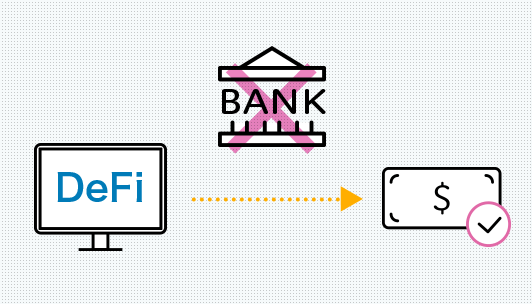
1.Transactions are possible without an administrator
For example, when transferring money to someone or making a transaction, CeFi requires the intervention of a bank, exchange, post office or similar intermediary. With DeFi, however, it is possible to perform transfers and trades without an intermediary through smart contracts on the blockchain.
2.Low fees
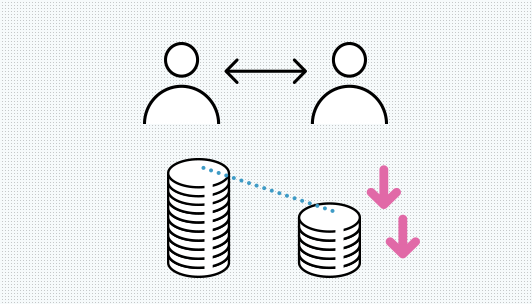
With CeFi, multiple intermediaries intervene, and additional fees are incurred. Using DeFi, on the other hand, fees can be kept low because there are no intermediaries and users can trade directly with each other (in situations where the blockchain is very congested, however, the fees may be high).
3.The service can be used by anyone, at any time
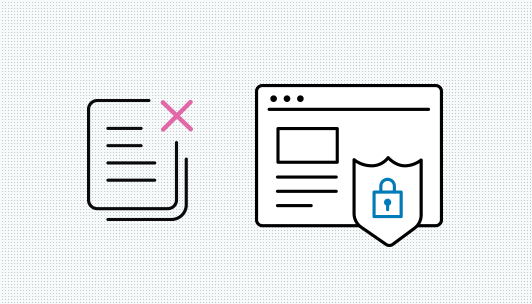
When starting to use a service such as opening or registering a new account with a bank or exchange that uses intermediaries, income examinations and credit checks are required. In the case of DeFi, however, there is no initial screening, and anyone can use the service at any time.
4.Interoperability between services is realized
In the field of software development, new systems are constructed by combining system components called modules. By proceeding in this way, development costs and time can be reduced, even for complex systems. This feature is called composability. This kind of composability is also an important aspect of DeFi.
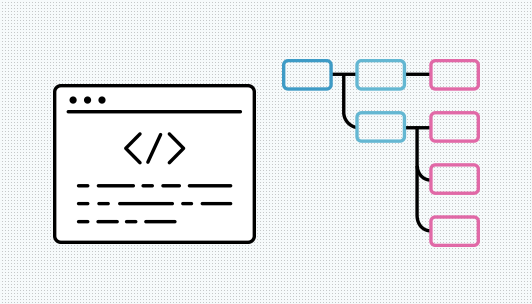
DeFi regards its smart contracts as modules. By combining them, it is possible to develop services that are complex but are still able to function efficiently. Because of this feature, DeFi is sometimes called, "Money Lego."
This feature has a positive effect, not only in terms of development but also for operations. With composability, it is possible to flexibly implement and expand interoperable functions, something that is not possible with existing finance systems. Asset management that aims for high investment performance is possible.
Many investors believe that CeFi systems are safer because they have administrators. This is not always the case, however.
CeFi carries with it the risk of hacking and other cyber-attacks utilizing unauthorized access to servers, phishing scams, and internal organizational factors. In fact, on centralized exchanges, large amounts of assets have been lost due to insufficient security measures on the part of the operating companies.
DeFi uses blockchain distributed ledger technology to manage data in a distributed manner on the Internet, making it possible to avoid the risks inherent in CeFi, as described above. However, with DeFi, users have to manage their assets themselves, and need to do so carefully since they are responsible for any troubles which occur related to their assets.
Advantages and disadvantages of using DeFi
The principal advantages and disadvantages of managing virtual currency using DeFi are as follows:
Advantages
- • High yields can be expected in a short time.
- • Operations can be started and stopped at any time.
- • Can be used even with small amounts of capital.
Disadvantages
- • Self-responsibility for asset problems and trouble related to investments.
- • Complicated risk management and calculation of fees and yields are required.
- • Constant information gathering and the making of operational decisions based on it are required.
DeFi users are most familiar with the operation of the Decentralized Exchanges (DEXs). Among them, Uniswap, SushiSwap, PancakeSwap, etc. are especially widely used. Unlike the centralized exchanges used by CeFi, trading on these DEXs can be performed 24 hours a day, 365 days a year.
In addition to the DEXs, the lending platforms MakerDAO and Compound are well-known services that are used for DeFi operations.
By combining these services, users can not only trade between virtual currencies, but also earn high yields in a short time by the deposit of virtual currencies. The yields that can be earned depends greatly on the amount of virtual currency deposited.
It is a great advantage for users to be able to earn yields from small amounts of capital. In addition, deposits can be started and stopped at any time at the user's discretion.
All asset problems and trouble related to operations are at the user’s own risk because the intermediary is eliminated and the programs are automatically executed. It is also important to note that it is necessary to constantly collect information and that making accurate judgments based on it is always required.
Asset management with DeFi
Our company offers DeFi asset management support using methods such as yield farming, liquidity mining, lending, and flash loans.
Some of the typical methods used for DeFi asset management are as follows:
Yield farming
Utilizing high-yielding DeFi, this is an method that sets interest efficiently. It is a method that aims to obtain yields and commission rewards from the deposit of virtual currency using DeFi.
Let's assume that a user has deposited 1 million units of USDT (a type of virtual currency) to the Ethereum-based Compound, which is the representative service of DeFi. At this time, the investor receives a token called cUSDT.
Transaction commissions can be earned by depositing this cUSDT in DeFi, which provides a liquidity pool.
Liquidity is a term used to describe how easy it is to trade a particular asset. The higher the liquidity, the smoother the asset trading.
For example, suppose a user wants to rent Ethereum on the lending service Compound. To do this, the Ethereum to be rented must be provided on Compound.
There, other users can rent Ethereum on Compound. In addition to the commission fee, you can get the virtual currency "COMP" issued by Compound.
By establishing such a mechanism, liquidity mining encourages users to participate in yield farming.
Lending
This is a method through which users can earn interest in return for lending their virtual currency people who want to borrow it.
DeFi which provide lending services include AAVE, in addition to the above-mentioned Compound.
Similar to Compound, virtual currency is lent and borrowed through the service, and users have the opportunity to earn yields by lending their virtual currency.
The lending yields that can be earned depend on the type of virtual currency used and also the DeFi service that handles the lending. It is important for users to compare the currency and DeFi service to be used with other options before making their final selections.
Flash loans
This is a method of acquiring cryptocurrency by, in a single transaction, borrowing a large amount of cryptocurrency and repaying it using a smart contract.
AAVE also offers flash loans as a DeFi service. With flash loans, if users borrow and return cryptocurrency in a single transaction, they can move hundreds of millions of yen worth of assets without collateral.
Flash loans, which were originally expected to be used for arbitrage between DeFi services, are expected to have a variety of uses because they can move large amounts of capital at once.
The operation method introduced here is not limited to the Ethereum blockchain but has also been used on other blockchain applications such as Binance Smart Chain and Solana blockchain, and on the sidechains developed for the purpose of expanding the blockchain’s functions. It is important to select the optimal method from the options available, depending on the situation, such as moving cryptocurrencies between different blockchains or converting to higher-yield cryptocurrencies, in order to obtain better operational results.
DeFi operations precautions
As mentioned above, users can expect large yields from DeFi asset management. At the same time, however, there are some risks. Here are three important points to help avoid them.
1:Private key and password protection
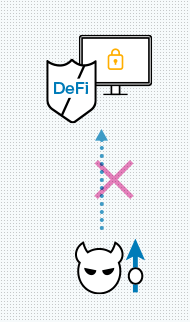
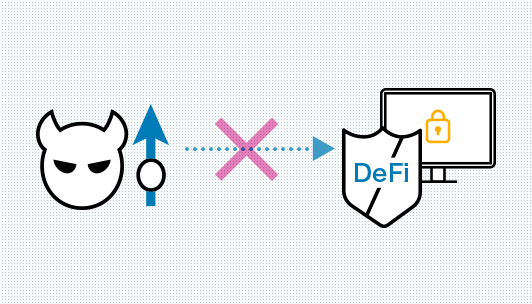
Many people understand the importance of increasing their online security. When engaging in DeFi operations, it is very important to manage the password of the asset management wallet and the private key and passphrase used to access the asset rights. Taking adequate measures to prevent the theft of passwords and private keys is crucial, but it is just as important to prevent the personal computer on which they are stored from malfunctioning.
Unlike CeFi, all the risk involved in DeFi falls on the user. It is, therefore, more important to strengthen one’s defense (against loss or theft) than offense (trying to obtain high yields). For example, it is necessary to take measures such as not using public Wi-Fi used by an unspecified number of people, preparing a dedicated terminal for DeFi operations, and not doing any unnecessary Internet surfing on that terminal.
At our company, we reduce the risk of malicious attacks on our computer system by using a dedicated line and terminal. We also focus on security measures such as having private keys managed by multiple people.
2:Address and chain management
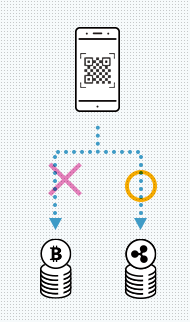
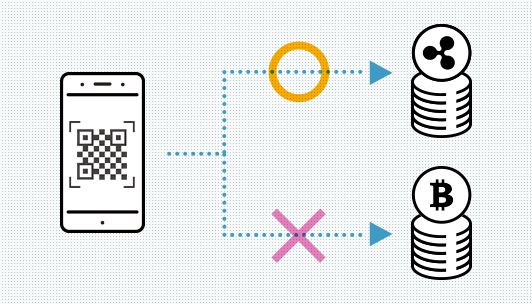
It may sound like rudimentary advice, but it is important for users to know the basic information related to cryptocurrency addresses and chains. For example, multiple addresses with different uses are employed, such as contract addresses and wallet addresses. If they are confused when virtual currency is sent, there is a risk of asset loss.
In addition, a variety of blockchain and side chain standards may be adopted for each project. If virtual currency is sent to a chain with different standards, there is also a risk of asset loss.
In order to reduce the risk of asset loss, it is very important to correctly understand the information on the destination address and chain standards which can differ for each type of virtual currency, and to transfer money only to the correct address and blockchain.
3:Don't be fooled by high yields
DeFi is not a numbers game, but a mechanism that allows users to receive rewards by contributing to the development of the project. It is important to choose a project that will be used by many people and bring some kind of innovation to the world, and not to be fooled by APY (yields) that appear high on the surface.
As a result, tokens will be valued and prices will rise, resulting in a yield above the apparent APY (or conversely, significantly below the suggested APY if you choose a bad project).
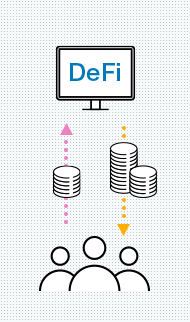
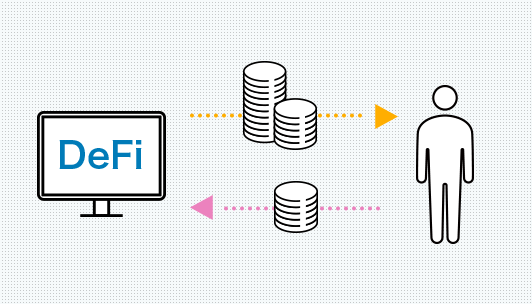
About our DeFi agency services
We provide DeFi operation agency services on behalf of our clients. As was explained earlier, there are various advantages and disadvantages to DeFi operations.
While DeFi operations can have great advantages, there can also be major disadvantages. As was mentioned above, there can be a number of troublesome issues such as operational problems, complicated fee calculations, and the constant need for risk management.
The current situation is that there are that DeFi users face some high barriers, such as cases where the destination address of the virtual currency is mistaken (such as transmission to an incorrect chain or contract address) and the capital is lost.
By using our investment agency service, however, users do not have to deal with problems related to assets and investments themselves, and there is no need to perform complicated fee and yield calculations, risk management, etc.
We aim for annual returns in the range of 50-140% by combining yield farming, liquidity mining, lending, flash loans, etc. Our clients are also able to check the status of their operations with the contract address and video. Dividends are distributed monthly.
As compensation for our services, we receive 30% of the operating profit as a commission in the end. It should be noted, therefore, that it is not possible for users to acquire 100% of the profit.